How to Make a Study Schedule for Finals: 7-Day Plan
By Ashraf
Last Reviewed: September 5, 2026
To make a study schedule for finals, begin with exam dates, course priorities and the topics you can and cannot recall without notes. Spread preparation across several days, use practice instead of endless rereading, and protect enough sleep and recovery time to think clearly on exam day.
Open the free College Schedule Maker to place each exam, review session, practice test and break on one timetable. You can adjust conflicts and print or save the final plan.
Quick Answer: How Do You Make a Study Schedule for Finals?
List every exam with its date, weight and weakest topics. Estimate the hours each course needs, then schedule short preparation and practice blocks across the available days. Give earlier exams and weaker subjects more time, mix recall with practice questions, keep one catch-up period open, and stop heavy studying early enough to sleep.
Step 1: Build a Finals Inventory
| Exam | Date and time | Course weight | Confidence | Priority topics |
|---|---|---|---|---|
| Biology | Monday, 9:00 AM | 30% | Medium | Genetics and cell respiration |
| Calculus | Wednesday, 1:00 PM | 35% | Low | Integrals and applications |
| History | Friday, 10:00 AM | 25% | High | Essay evidence and timeline |
Check the official syllabus or course portal instead of relying on memory. Record exam location, format, allowed materials and any review-session dates. If your final grade target matters, use the Grade Calculator before assigning study hours.
Step 2: Rank Exams by Priority
Priority is not based on fear alone. Consider four factors:
- Timing: an earlier exam needs earlier preparation.
- Weight: a heavily weighted final can have more influence on the course grade.
- Current understanding: weak topics need more preparation and feedback.
- Type of work: problem solving and essay planning often need repeated practice, not one reading session.
Use priority to distribute time, but do not ignore a strong subject completely. A short retrieval session can keep familiar material available while most time goes to weaker areas.
Step 3: Break Each Course Into Study Tasks
| Too broad | Scheduled task |
|---|---|
| Study biology | Explain genetics concepts without notes, then complete 20 questions |
| Review calculus | Redo missed integral problems and record error patterns |
| Prepare history | Outline two possible essays using evidence from memory |
| Read notes | Create and answer a closed-note self-test |
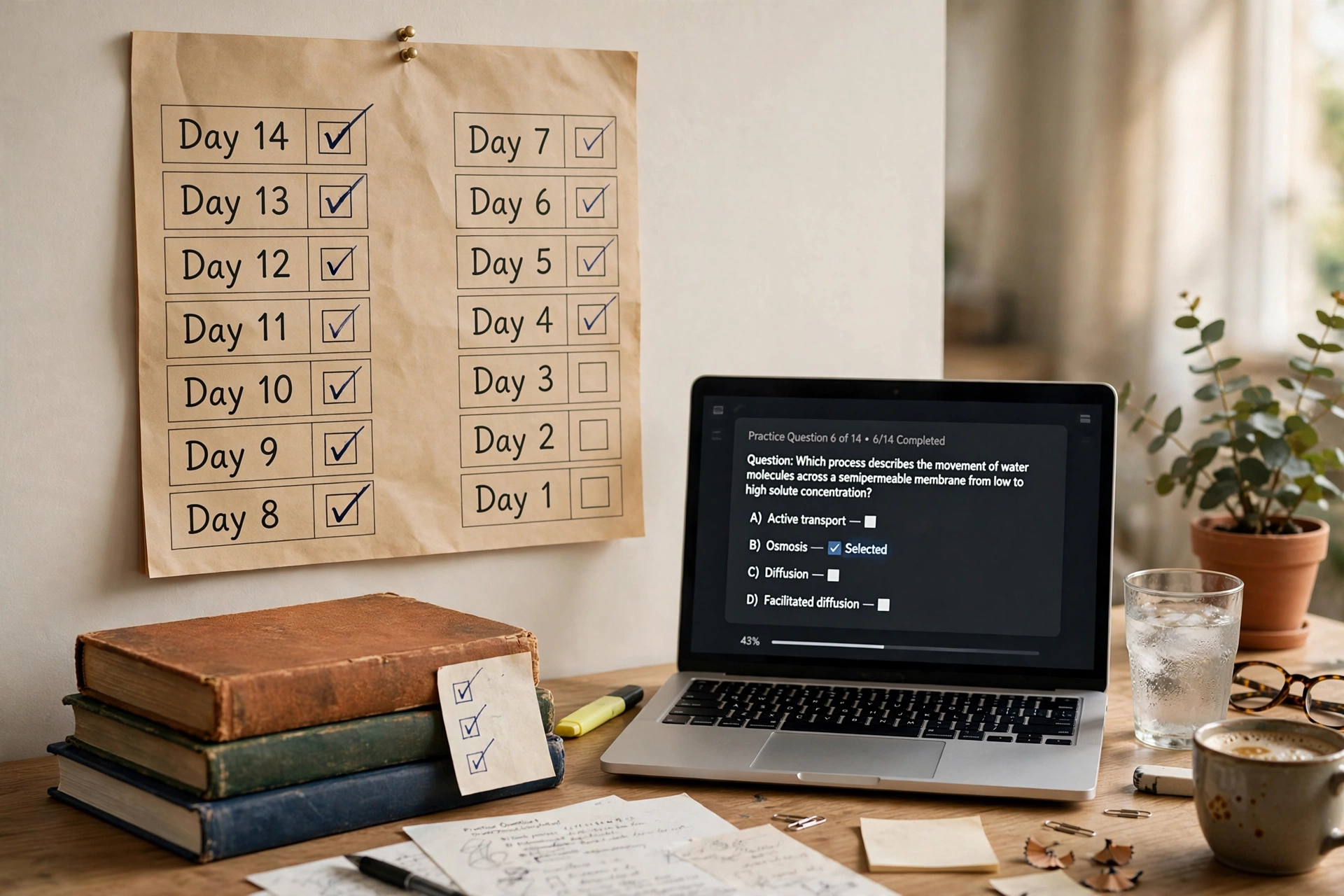
A Realistic 7-Day Finals Study Plan
| Day | Main action | Second action |
|---|---|---|
| Day 1 | Confirm exam details and divide material into sections | Complete a short diagnostic quiz |
| Day 2 | Prepare the weakest section | Recall Day 1 material without notes |
| Day 3 | Prepare the second section | Complete mixed practice from Days 1–2 |
| Day 4 | Prepare the remaining section | Review errors and missing concepts |
| Day 5 | Complete a timed or closed-note practice set | Repair the two weakest areas |
| Day 6 | Complete mixed retrieval across all sections | Prepare materials and confirm logistics |
| Day 7 | Use a short confidence check | Stop heavy study, eat and sleep |
If you have more than seven days, expand the preparation and practice cycle. Cornell’s Five-Day Study Plan emphasizes repeated preparation and review rather than concentrating all work into one or two long sessions.
What to Do Inside Each Study Block
Retrieval Practice
Close your materials and explain, solve or write what you remember. Check the answer afterward and correct gaps. This gives you clearer evidence than recognizing familiar words on a page.
Practice Questions
Use instructor-provided questions, textbook problems, previous quizzes or questions you create. Match the format and time pressure of the real exam when possible.
Spaced Review
Return to important material on different days. The UNC Learning Center’s finals guidance recommends using a planner and distributing practice while deciding how many hours each exam needs.
Error Review
Do not only count correct answers. Record why each error happened: missing knowledge, misunderstood instructions, weak procedure or rushed work. Schedule the repair, then test the topic again.
What If Finals Start in Two or Three Days?
- Confirm exactly what is tested and remove low-value tasks.
- Use a short diagnostic to find the biggest knowledge gaps.
- Prioritize high-weight topics that are likely to appear.
- Practice recall and exam-style questions instead of repeatedly rereading.
- Use one catch-up block, but do not schedule the entire night.
- Ask the instructor or teaching assistant about unclear exam logistics.
Return to your normal college study schedule after finals. For a reusable weekly layout, copy the college study schedule template.
Common Finals-Planning Mistakes
- Giving every exam equal time regardless of date, weight or confidence.
- Writing only course names instead of specific topics and actions.
- Scheduling long sessions with no planned breaks.
- Spending all available time rereading familiar notes.
- Ignoring exam location, allowed materials or travel time.
- Replacing sleep with low-quality late-night review.
How This Finals Guide Was Checked
I tested this sequence in Scheduloom’s current weekly calendar on August 29, 2026, checking that preparation, practice, breaks and exam logistics could fit without overlapping. I also cross-checked the plan with current Cornell and UNC learning-center guidance on distributed review, specific study tasks and exam planning. The seven-day table is a flexible model rather than a promise of a particular grade.
FAQs
How early should I make a finals study schedule?
Start as soon as the exam dates and tested material are clear. A week or more gives you room for repeated practice, but a shorter plan is still useful if you prioritize topics and avoid spending time making the calendar overly detailed.
How long should each finals study session be?
Choose a block long enough to complete one defined task while keeping your attention. Many students begin with 45–60 minutes followed by a real break, but difficult practice exams may require a longer timed block.
Should I study multiple subjects in one day?
Yes, when several exams are close together. Give the highest-priority course the strongest focus window, then use a shorter block for another subject. Switching subjects can also prevent one course from consuming the entire day.
What should I do the night before a final?
Use a short confidence check, review only a few weak points, prepare permitted materials, confirm the location and set alarms. Avoid beginning large new topics unless the exam plan shows they are essential.
Finals Study Plans for 1 Day, 2 Days, 1 Week and 2 Weeks
Your exam study plan should change with the time available. A short plan must prioritize tested topics and practice, while a longer plan can use repeated retrieval and spaced review.
How to Study for an Exam in 1 Day
Confirm the exam format, list the highest priority topics, and complete a short diagnostic test. Spend most of the remaining time repairing the largest gaps with practice questions. Finish with one closed-note recall check and stop early enough to sleep. Do not try to reread the entire course.
How to Study for an Exam in 2 Days
Use Day 1 to diagnose weaknesses and prepare the most important material. Use Day 2 for mixed practice, error correction and a final recall check. Divide both days into focused blocks with meals, breaks and a defined stopping time.
How to Study for Final Exams in 1 Week
Assign the first four days to preparation and repeated recall, Day 5 to mixed or timed practice, Day 6 to weak areas, and Day 7 to a lighter confidence check. The seven-day table above gives a complete schedule you can copy.
How to Study for Final Exams in 2 Weeks
Use the first week to divide the syllabus, repair missing understanding and build recall material. Use the second week for cumulative practice, timed work and error review. Revisit each course several times instead of finishing one subject and ignoring it for the remaining days.
How Many Hours Should You Study for a Final?
There is no universal number. Estimate time from the exam weight, your current understanding, the amount of tested material and the type of practice required. Give the earliest and weakest high-value exam the most time, then protect short review blocks for the other courses.
| Situation | Starting allocation | Best use |
|---|---|---|
| Strong subject | One short block most days | Retrieval and mixed questions |
| Average subject | One main block plus review | Practice and error correction |
| Weak or heavily weighted subject | Two separated blocks on priority days | Repair concepts, then test them |
Use the Grade Calculator when exam weight affects your priority, then place the selected blocks in the College Schedule Maker.
What Comes Before Finals?
Before finals week, confirm the official exam dates, locations, formats, permitted materials and tested topics. Complete major assignments first, collect missing notes, ask questions while instructors are available, and run a short diagnostic test for every course. This preparation turns the final timetable into a study plan instead of a list of exam dates.




3 Comments