Study Schedule for ADHD College Students
By Ashraf
Last Reviewed: October 16, 2026
A study schedule for ADHD college students works best when it is short, visual, and forgiving. Use 25 to 45 minute blocks with visible timers. Put every task on one calendar you can actually see. Build in catch-up time instead of punishing yourself for missed blocks. The goal is a schedule you will reopen tomorrow, not a perfect one you abandon by Wednesday.
Open the free College Schedule Maker and put classes, work shifts, and study blocks on one visual timetable.
Quick Answer: How Should an ADHD Student Plan Study Time?
Break study time into short, timed blocks with one clear task each. Put every commitment on one visible calendar. Alternate hard and easy tasks, and add two or three catch-up blocks per week so a missed session moves instead of breaking the plan. Review the plan every Sunday for ten minutes. The schedule serves you, not the other way around.
Why Typical Study Schedules Fail for ADHD Students
Most study advice assumes you can sit down for three hours because the calendar says so. For students with ADHD, the failure points are predictable, and they are not a character problem: Time blindness: a two-hour block feels the same as a twenty-minute one. Task initiation: starting is harder than continuing, so vague blocks like “study biology” never begin. Working memory: the plan lives in your head, and your head is busy, so the plan vanishes. All-or-nothing thinking: one missed session feels like proof the whole schedule is ruined. A schedule that works with ADHD is built around these four points: timers for time blindness, single named tasks for initiation, one visible calendar for working memory, and catch-up blocks for the all-or-nothing trap.

The Core Rules of an ADHD-Friendly Study Plan
Table (columns: Rule | What it looks like | Why it works): Short timed blocks | 25 to 45 minutes, visible timer running | Makes time concrete. One task per block | “Redo problem set 4, questions 1 to 8” | No decisions needed to start. External everything | One calendar, one task list, both visible | Stops relying on working memory. Planned catch-up | 2 to 3 flexible blocks per week | A missed session moves, it does not break. Body doubling | Study near others, in person or virtual | External presence steadies attention. Sunday reset | 10-minute weekly review | Resets before drift piles up.
How Long Should Study Sessions Be for Someone with ADHD?
Most students with ADHD do best with blocks of 25 to 45 minutes, each with one specific task and a visible timer. A 25-minute block feels doable on a bad day, and you can always keep going if focus holds. Some students prefer even shorter rounds of 15 to 20 minutes for boring or hard material. Match the length to the task: longer blocks for strong-interest work, short ones for the boring stuff. A useful planning formula: budget about 2 to 2.5 hours of study per week for every course credit hour. A 15-credit semester means roughly 30 to 37 hours per week, split into small blocks instead of one giant wall of work.
Build Your Weekly Study Schedule
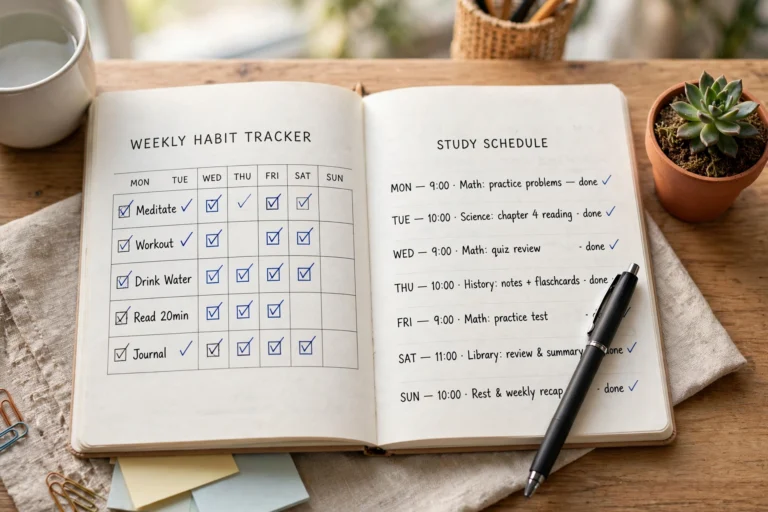
A good study schedule for ADHD college students answers three questions before the week starts: what am I doing, when, and what happens if I miss it. The sample below assumes 15 credits with classes ending around 3 PM. Adjust the hours, but keep the structure.
Table (columns: Day | Study blocks | Notes): Monday | 4:00 to 4:40 PM: problem set, timer on; 5:00 to 5:40 PM: lecture recall | Alternate hard task with lighter recall. Tuesday | 10:00 to 10:30 AM: readings before class; 4:00 to 4:45 PM: lab prep | Uses a gap between classes. Wednesday | 4:00 to 4:40 PM: essay outline; 6:00 to 6:30 PM: flashcards | Body double at the library for the hard block. Thursday | 4:00 to 4:45 PM: redo missed quiz problems | Error repair is high-value and specific. Friday | 3:00 to 3:40 PM: weekly review; 4:00 to 4:30 PM: plan next week | Finish the week, do not start new material. Saturday | 10:00 to 10:45 AM: catch-up block; 11:00 to 11:30 AM: catch-up block | Only what slipped, protect the afternoon. Sunday | 4:00 to 4:10 PM: review the calendar; rest | Ten-minute reset, then a real day off.
Three features matter more than the exact times: every block names a concrete task, catch-up blocks absorb missed sessions, and Friday and Sunday stay mostly protected. Build this layout in the free study schedule maker and color-code classes, study blocks, and breaks.
How Do I Actually Start a Study Block with ADHD?
The calendar gets you to the desk; the first five minutes decide whether the block happens. Use the same start ritual every time: 1. Open only what the task needs. Close everything else before the timer starts. 2. Write the single task on paper. One sentence: “Outline the causes section of the history essay.” 3. Start the timer where you can see it. A phone across the room does not count. 4. Give yourself a five-minute on-ramp: you only have to do five minutes. Starting is the hard part; continuing usually follows. If the block still will not start after five minutes, the task is too big or too vague. Split it in half or name it more precisely, then restart the timer. This is a planning fix, not a willpower failure.
Does the Pomodoro Technique Work for ADHD?
Yes, with tweaks. The classic Pomodoro is 25 minutes of work followed by a 5-minute break. Many students with ADHD do better with shorter rounds, such as 15 to 20 minutes of work with a 10-minute break, or even 10-minute work bursts on rough days. The point is not the exact numbers. The point is a timer that marks clear starts and stops. Three ADHD-specific tweaks make it work better: Use a visible countdown. A desk timer or a propped-up phone beats a silent phone timer. Stay off your phone during breaks. Five minutes of scrolling can swallow an hour. Walk, stretch, or get water instead. Name one goal per round. “Finish 20 flashcards” beats “study chemistry.” Pair short blocks with active study methods: rewrite notes instead of rereading them, quiz yourself, or teach the concept out loud. For a deeper breakdown of timer-based studying, see our Pomodoro study schedule guide.
How Do I Keep Deadlines Visible All Week?
ADHD makes distant deadlines invisible until they are emergencies. Make every deadline visible: Work backward from each deadline and place the pieces on the calendar as dated blocks: research Tuesday, first draft Thursday, revise Sunday. Use a weekly review (the Friday block above) to check every syllabus for the next two weeks. Surprises are the enemy. Pair each deadline with a person. Tell a friend or tutor what you will have done by when. External accountability covers you when motivation dips. Put the plan where you cannot avoid it. A phone widget, a printed page on the desk, a whiteboard. Wherever your eyes land without effort. Spread big exams the same way: break them into daily pieces across two weeks. Our two-week exam study plan shows how.
What to Do When the Schedule Falls Apart
It will fall apart some weeks. Students who recover have a written recovery procedure: 1. Do not delete the plan. A broken week on the calendar is data, not evidence of failure. 2. Move, do not erase. Drag the missed block into the nearest catch-up slot. 3. Shrink the next block. Do 20 minutes instead of 40. A small kept promise restarts momentum. 4. Check the pattern on Sunday. If evening blocks always fail, stop scheduling evening blocks. Change the plan to match reality. Plan for your average days, not your best ones. For habit systems that survive bad weeks, read our guide on how to stick to a study schedule.
When to Get More Support on Campus
A good schedule handles a lot, but it is not treatment. If focus problems persist outside studying or seriously affect grades, sleep, or daily life, talk to your campus counseling center or disability services office. Two campus resources are worth knowing about. Disability services offices can arrange accommodations such as extended test time, reduced-distraction testing rooms, or note-taking support. Academic coaching and tutoring centers help students build planning and study skills one on one. Both are normal and common, and using them is a strategy, not a confession. If your school offers an ADHD support group or workshop series, join it. Studying next to other students who get it is body doubling with a built-in support network.
Non-medical-advice disclaimer: This guide covers study scheduling only. It is not medical advice, diagnosis, or treatment for ADHD, and it does not replace professional evaluation or care.
How This Guide Was Prepared
I built this weekly structure in Scheduloom’s calendar tool to confirm it fits a realistic 15-credit schedule, then cross-checked the strategies against current guidance from the Cornell Learning Strategies Center, the UNC Learning Center, the University of Pennsylvania’s Weingarten Center, and Verywell Mind’s college ADHD guide.
FAQs
How long should study blocks be for ADHD?
Most do best with 25 to 45 minute blocks, each with one specific task and a visible timer. Use shorter 15 to 20 minute rounds for boring material and longer blocks only for strong-interest tasks. You can always continue if focus holds.
What is body doubling and does it help studying?
Body doubling means working near another person who is also working: at a library table, a cafe, or a virtual study room. Many students with ADHD find that quiet company makes it easier to start and stay on task.
Should I use a paper planner or a digital calendar?
Use whichever one you will actually look at. The best system is the one that stays visible: a phone widget you see every time you unlock the screen, a printed weekly page on your desk, or a whiteboard. If you have to remember to open it, it will not survive a busy week.
How do I handle days when nothing works?
Have a minimum day: one 20-minute block on the single most important task, then stop without guilt. It keeps the “I studied today” streak alive and stops one bad day from becoming a lost week.
Can a student with ADHD do well in college?
Yes. Students with ADHD succeed in college once they build systems that fit their brains: visible schedules, timers, task lists, and accountability partners. Adding campus support, like academic coaching or accommodations, helps even more.
Is a study schedule for ADHD college students enough on its own, or is professional help needed?
A study schedule is a tool, not treatment. It helps many students study more effectively, but it cannot replace professional care. If ADHD symptoms significantly affect your grades, sleep, or daily life, speak with a healthcare provider or your campus counseling center.





One Comment