Calculate your current grade, weighted average, test score, or the grade you need on a final exam. Enter your scores, points, or assignment weights in the grade calculator to get your result and see how the calculation works.
By Ashraf
Last reviewed: September 5, 2026
How this calculator is checked: The calculations use standard percentage and weighted-average arithmetic and are checked against worked examples. Letter-grade cutoffs can vary by school, instructor, and course, so always use the grading scale in your syllabus when available.
Calculate your grade and see what you need next
Use weighted scores, points, final-exam planning, or a what-if scenario. Results are calculated in your browser.
The calculator can be used for weighted grades, points-based grades, and final-grade planning.
How to Use the Grade Calculator
Choose the calculation that matches the information you have.
Calculate Your Current Grade
If all of your assignments count equally, enter your scores and calculate their average.
For example, suppose your grades are:
- 90%
- 82%
- 88%
- 94%
Add the four scores and divide by four.
(90 + 82 + 88 + 94) ÷ 4 = 88.5%
Your average grade is 88.5%.
If your assignments have different weights, use the weighted-grade option instead.
Calculate a Grade Using Points
If your class uses points, enter the points earned and the total points possible.
For example:
Points earned: 43
Points possible: 50
Calculation:
43 ÷ 50 × 100 = 86%
Your grade is 86%.
Calculate Your Grade by Weight
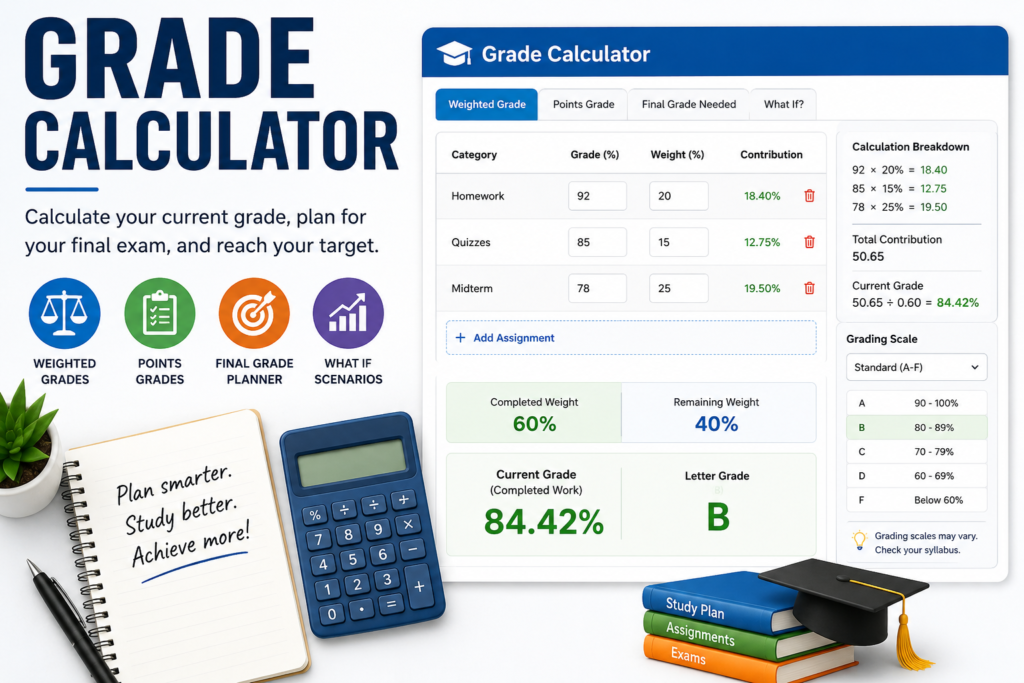
Use weighted calculation when homework, quizzes, projects, exams, or other categories count for different percentages of your course.
For example:
| Category | Grade | Weight |
|---|---|---|
| Homework | 92% | 20% |
| Quizzes | 85% | 15% |
| Midterm | 78% | 25% |
The midterm affects your course grade more than the quiz category because it carries a larger weight.
How Are Grades Calculated?
The method depends on whether your course uses points, equally weighted scores, or weighted assignments.
Grade Percentage Formula
For a points-based grade:
Grade Percentage = Points Earned ÷ Points Possible × 100
If you earned 72 points out of 80:
72 ÷ 80 × 100 = 90%
Your grade is 90%.
Grade Average Formula
If every score counts equally, add your scores and divide by the number of scores.
For grades of 80%, 90%, 85%, and 95%:
(80 + 90 + 85 + 95) ÷ 4 = 87.5%
Your average grade is 87.5%.
Weighted Grade Calculator
A weighted grade gives some assignments or categories more influence than others.
An exam worth 30% of your course grade has a greater effect on your final average than an assignment worth 5%.
How to Calculate a Weighted Grade
Multiply each grade by its weight and add the results.
Suppose you have:
| Category | Score | Weight | Contribution |
|---|---|---|---|
| Homework | 92% | 20% | 18.40 |
| Quizzes | 85% | 15% | 12.75 |
| Midterm | 78% | 25% | 19.50 |
The calculation is:
92 × 0.20 = 18.40
85 × 0.15 = 12.75
78 × 0.25 = 19.50
The entered work contributes 50.65 percentage points toward the complete course grade.
These categories make up 60% of the course, so the current average on the work entered is:
50.65 ÷ 0.60 = 84.42%
Your current grade on that completed work is about 84.4%.
Category Weighting vs. Individual Assignment Weighting
Some courses assign weights to categories.
For example:
- Homework: 20%
- Quizzes: 15%
- Projects: 25%
- Exams: 40%
Other courses give individual assignments their own weights or use a total-points system.
Check your syllabus before entering weights so the calculation matches the grading system your instructor actually uses.
What if Your Weights Do Not Add Up to 100%?
That can be completely normal while a course is still in progress.
If the grades entered represent only 65% of your course, the calculator should separate:
Completed weight: 65%
Remaining weight: 35%
Your current average should be based on the completed work rather than automatically treating the ungraded 35% as zero.
Current Grade vs. Final Course Grade
Your current grade reflects your performance on work completed so far.
Your final grade includes all graded assignments, projects, exams, and other course requirements after the course is complete.
The two numbers may be different during a semester.
Final Grade Calculator
Use the final grade calculator to find the score you need on an upcoming final exam or remaining coursework to reach your desired overall grade.
What Grade Do I Need on My Final?
Suppose:
Current grade: 84%
Course completed: 70%
Final exam weight: 30%
Desired final grade: 88%
Your completed coursework contributes:
84 × 0.70 = 58.8
To finish with 88%, you still need:
88 – 58.8 = 29.2
The final is worth 30%, so:
29.2 ÷ 0.30 = 97.33%
You would need approximately 97.3% on the final exam to finish the course with an 88%.
Calculate the Grade Needed on Remaining Work
The same idea works when more than one assignment remains.
Enter:
- your current grade
- the percentage of the course completed
- the percentage remaining
- your desired final grade
The calculator can then show the average you need across the remaining coursework.
What if the Required Grade Is Over 100%?
If the calculator says you need 108%, the target cannot normally be reached through the remaining coursework using the values entered.
Extra credit, a dropped assignment, a curve, or another grading adjustment could change the outcome if your instructor allows it.
Test Grade Calculator
A test grade calculator converts the points you earned into a percentage.
Calculate a Test Grade From Points
If you earned 46 points out of 50:
46 ÷ 50 × 100 = 92%
Your test grade is 92%.
Convert a Test Score to a Percentage
The same calculation works for quizzes, assignments, projects, and exams.
If you earned 37 points out of 45:
37 ÷ 45 × 100 = 82.22%
Your score is approximately 82.2%.
Convert a Percentage to a Letter Grade
Compare the percentage with the grading scale used by your school or course.
Do not assume that every school uses exactly the same letter-grade cutoffs.
Grade Calculator Examples
Here are three common situations.
Points-Based Grade Example
You earned 43 points out of 50.
43 ÷ 50 × 100 = 86%
Your grade is 86%.
Weighted Course Grade Example
Suppose your course currently has:
- Homework: 94% worth 20%
- Quizzes: 87% worth 20%
- Midterm: 82% worth 25%
- Project: 90% worth 15%
Their contributions are:
94 × 0.20 = 18.8
87 × 0.20 = 17.4
82 × 0.25 = 20.5
90 × 0.15 = 13.5
Total contribution:
18.8 + 17.4 + 20.5 + 13.5 = 70.2
The work entered represents 80% of the course.
70.2 ÷ 0.80 = 87.75%
Your current average on the completed work is 87.75%.
Final Grade Needed Example
Suppose:
Current grade: 86%
Course completed: 75%
Target grade: 88%
Course remaining: 25%
Completed contribution:
86 × 0.75 = 64.5
Points still needed:
88 – 64.5 = 23.5
Required average on the remaining 25%:
23.5 ÷ 0.25 = 94%
You need an average of 94% on the remaining work to finish with an 88%.
Percentage to Letter Grade
The table below is an example plus/minus grading scale. Your school or instructor may use different cutoffs.
| Percentage | Letter Grade |
|---|---|
| 93–100% | A |
| 90–92% | A- |
| 87–89% | B+ |
| 83–86% | B |
| 80–82% | B- |
| 77–79% | C+ |
| 73–76% | C |
| 70–72% | C- |
| 67–69% | D+ |
| 63–66% | D |
| 60–62% | D- |
| Below 60% | F |
Custom Grading Scales
Your course may use different letter-grade boundaries.
For example, one instructor may consider 90% an A, while another course may require a higher percentage.
Use the grading scale in your syllabus whenever possible.
If the calculator includes a custom-scale option, enter the exact cutoffs used by your class.
Common Grade Situations
Some grading systems include rules that require extra care.
Extra Credit
Extra credit may add points, bonus percentage points, or an additional weighted category.
Enter it according to the method your instructor uses rather than assuming every extra-credit assignment works the same way.
Dropped Lowest Grade
If your instructor drops your lowest quiz or assignment, exclude that score when calculating your grade unless the calculator has a specific option for dropped grades.
Late Assignment Penalties
Use the grade you expect to receive after the late penalty is applied.
For example, if the original score would have been 90% but a penalty reduces it to 80%, use 80% in the calculation.
Missing or Ungraded Assignments
An ungraded assignment is not necessarily the same as a zero.
Do not enter zero for work that is simply waiting to be graded unless your instructor or gradebook has actually recorded it as zero.
How Much Can One Assignment Change Your Grade?
The effect of an assignment depends heavily on its weight.
A quiz worth 5% of your course usually has less impact than a final exam worth 30%.
Assignment Impact Example
Suppose your current average is 84% across 80% of the course.
Your completed work contributes:
84 × 0.80 = 67.2
The next exam is worth the remaining 20%.
If you score 70%:
70 × 0.20 = 14
Projected final grade:
67.2 + 14 = 81.2%
If you score 90%:
90 × 0.20 = 18
Projected final grade:
67.2 + 18 = 85.2%
A 20-point difference on this exam changes the projected final course grade by 4 percentage points.
Try Different Grade Scenarios
A what-if calculation lets you test different scores before an assignment is graded.
For example:
What if I get 75% on my final?
What if I get 90% on my project?
What if my lowest quiz is dropped?
Testing different scenarios can show which remaining assignments have the greatest potential effect on your final grade.
From Your Target Grade to a Study Plan
Once you know the grade you need, look at the work that remains.
If you need a 92% average on your remaining coursework, start with assignments and exams that have the largest weights and closest deadlines.
Break the work into manageable study sessions instead of leaving everything until the final exam.
Create a study schedule for your remaining assignments and exams.
FAQS
How do I calculate my grade?
For a points-based grade, divide the points earned by the total points possible and multiply by 100. If assignments have different weights, calculate a weighted average instead.
How do I calculate my grade with percentages?
If every assignment counts equally, add the percentages and divide by the number of assignments. If assignments count differently, use their weights.
How do I calculate a weighted grade?
Multiply each grade by its corresponding weight and add the contributions. If the completed weights do not total 100%, divide the total contribution by the amount of course weight entered to calculate your current average.
What grade do I need on my final?
Use your current grade, completed course weight, final exam weight, and desired overall grade. The final grade calculator can determine the score required on the exam.
How do I calculate a test grade?
Divide the points earned by the points possible and multiply by 100.
For example:
45 ÷ 50 × 100 = 90%
How do I calculate my grade average?
For equally weighted grades, add all scores and divide by the number of scores. If the assignments have different weights, calculate a weighted average.
Can I still pass my class?
That depends on your current grade, the amount of coursework remaining, the passing grade required by your course, and the scores you earn next.
Use the final-grade calculation to see what average you need on your remaining work.
What happens if my weights do not add up to 100%?
Part of your course may simply be incomplete or ungraded. Calculate your current average using the completed weight and keep the remaining course percentage separate.
Is 80% a B?
It can fall within the B range on some grading scales, but your course may use different cutoffs. Check your syllabus for the grading scale that applies to you.
Can a Grade Be Higher Than 100% With Extra Credit?
Yes, a grading system can produce a score above 100% when extra credit is allowed. Whether that increases your final course grade depends on how your instructor calculates extra credit.