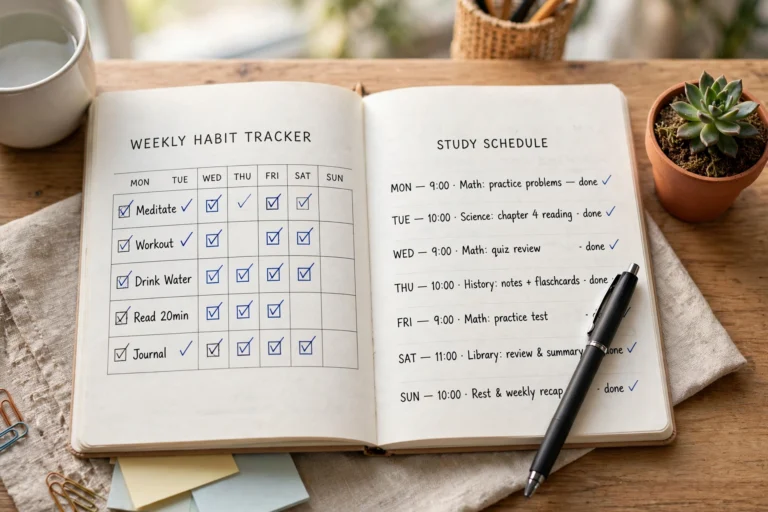
Study Schedule for College Freshmen: A Weekly Plan That Works
By Ashraf
Last reviewed: August 25, 2026
Starting college changes how you manage your time. No one may remind you about tomorrow’s reading, next week’s quiz, or the paper due at the end of the month. A weekly plan helps you handle that freedom without studying all day.
Quick answer: Add your classes, commute, meals, sleep, work, and fixed commitments first. Next, schedule two to three hours of weekly preparation for each credit hour. Divide that time into focused blocks and leave at least one catch-up block open each week.
College Freshman Study Schedule at a Glance
| Step | What to schedule | Recommended approach |
|---|---|---|
| 1 | Classes and labs | Add every fixed class time first |
| 2 | Sleep | Protect a consistent sleep window |
| 3 | Study time | Start with 2–3 hours per credit each week |
| 4 | Focused sessions | Use 30–50 minute study periods |
| 5 | Difficult subjects | Place them during your most alert hours |
| 6 | Catch-up time | Keep at least one flexible block each week |
| 7 | Weekly review | Check deadlines and adjust every Sunday |
| 8 | Personal time | Include meals, exercise, friends, and rest |
The goal is not to fill every open hour. Your schedule should show when you will work, what you will study, and when you can stop for the day.

You can use the free College Schedule Maker to place your classes and study blocks into one weekly timetable.
How Many Hours Should a College Freshman Study?
A useful starting point is two to three hours of preparation outside class for every hour spent in class. Dickinson College uses this guideline to help students estimate college-level workloads.
| Course load | Starting weekly study range |
|---|---|
| 9 credit hours | 18–27 hours |
| 12 credit hours | 24–36 hours |
| 15 credit hours | 30–45 hours |
| 18 credit hours | 36–54 hours |
These numbers are planning estimates, not fixed requirements. A writing course may require more time during a major paper. A math course may become heavier before an exam. Labs, group projects, and clinical work can also change the calculation.
Track your actual time for two weeks. If you understand the material and submit good work on time, your schedule is probably close to the right level. If deadlines keep surprising you, add more preparation time before adding new activities.
Build Your Freshman Schedule in Seven Steps
1. Add every fixed commitment
Begin with activities you cannot easily move:
- Classes
- Labs
- Work shifts
- Commute time
- Meals
- Sports or club meetings
- Religious commitments
- Medical appointments
Do not schedule study blocks until these commitments are visible. Otherwise, you may create a plan that looks good but cannot work in real life.
2. Protect your sleep
Sleep should be part of your timetable, not whatever time remains after studying.
The CDC recommends at least seven hours of sleep for adults ages 18 to 60. Students who are still 17 generally need eight to ten hours.
Choose a realistic sleep and wake time based on your first class, commute, work, and natural energy pattern. If you concentrate better later in the day, use this college schedule for night owls to adjust your study hours without cutting sleep.
3. Estimate the workload for each course
Do not give every subject the same amount of time. Estimate the work based on:
- Credit hours
- Reading load
- Weekly assignments
- Lab reports
- Quiz frequency
- Upcoming exams
- Your current understanding of the subject
A difficult three-credit course may need more study time than an easier four-credit class.
4. Match difficult work to your best hours
Use your strongest hours for tasks that require deep thinking. This may include:
- Solving practice problems
- Writing essays
- Studying technical concepts
- Reviewing difficult lecture material
- Preparing for exams
Save lighter periods for organizing notes, checking the learning portal, formatting assignments, or reviewing flashcards.
Students taking math, engineering, biology, computer science, or other technical courses can use the STEM-major study schedule for more practice and lab planning.
5. Decide what each block is for
“Study biology” is too broad. A clear task is easier to start and finish.
Instead, write:
- Review Biology Chapter 3 notes
- Complete Calculus problems 1–15
- Create five questions from today’s psychology lecture
- Draft the introduction for the history paper
- Review chemistry mistakes from the last quiz
Every block should have one main outcome.
6. Leave flexible time
Keep at least one open catch-up block each week. Use it for:
- An assignment that took longer than expected
- A missed study session
- Exam preparation
- Group-project delays
- Unexpected personal commitments
If nothing needs attention, the block becomes free time.
7. Review the plan every week
Spend 15 to 20 minutes each Sunday checking:
- Assignments due during the next seven days
- Tests and quizzes
- Readings
- Work shifts
- Group meetings
- Personal appointments
Move blocks before the week begins. Do not wait until you are already behind.
For a guided setup, follow the complete instructions on how to create a college study schedule.
Sample Weekly Schedule for a 15-Credit Freshman
The following example includes 30 hours of study outside class. It represents the lower end of the 30-to-45-hour starting range for a 15-credit course load.
Add these blocks around your actual classes rather than copying the times without checking your timetable.
| Day | Study blocks | Main purpose | Total |
|---|---|---|---|
| Monday | 8:00–9:30 AM, 2:00–4:00 PM, 7:00–8:30 PM | Review, assignments, practice | 5 hours |
| Tuesday | 9:00–10:30 AM, 1:00–3:00 PM, 6:30–8:00 PM | Reading, writing, review | 5 hours |
| Wednesday | 8:00–9:30 AM, 2:00–4:00 PM, 7:00–8:30 PM | Review, assignments, practice | 5 hours |
| Thursday | 9:00–10:30 AM, 1:00–3:00 PM, 6:30–8:00 PM | Reading, writing, review | 5 hours |
| Friday | 9:00–11:00 AM, 1:00–3:00 PM | Weekly assignments and catch-up | 4 hours |
| Saturday | 10:00 AM–12:30 PM, 2:00–4:30 PM | Projects and exam preparation | 5 hours |
| Sunday | 4:00–5:00 PM | Weekly review and planning | 1 hour |
| Weekly total | 30 hours |
This is a starting template. Some students will need more time before exams or major deadlines. Others may complete certain courses faster.
Create your own version with the college study schedule template.
Use the Time Between Classes
A one-hour gap can be useful even when it is too short for a major assignment.
| Available time | Good task |
|---|---|
| 10 minutes | Check deadlines or review flashcards |
| 20 minutes | Preview the next lecture or organize notes |
| 30 minutes | Review one concept or begin a reading |
| 45 minutes | Complete a focused problem set |
| 60 minutes | Draft a section, study a chapter, or visit office hours |
| 90 minutes | Work on a paper, lab report, or major assignment |
Short campus gaps are often better for review than commuting back to a dorm or apartment.
How Long Should Each Study Session Be?
The University of Colorado’s Study Cycle recommends focused study sessions of about 30 to 50 minutes, followed by a short break.
A simple session can look like this:
| Stage | Time | Action |
|---|---|---|
| Set the target | 2 minutes | Choose one clear outcome |
| Focused study | 30–50 minutes | Work without unrelated tabs or notifications |
| Recall | 5 minutes | Close your materials and explain what you learned |
| Check | 5 minutes | Correct mistakes and note unclear points |
| Break | 5–10 minutes | Stand, walk, drink water, or rest your eyes |
A long study session is not automatically a productive one. The useful measure is whether you can solve, explain, compare, or apply the material afterward.
Ohio University’s study strategies also recommend active approaches such as practice questions, self-testing, explaining ideas, and studying in a suitable environment.
Adjust the Schedule to Your Living Situation
Students living in a dorm
Dorms make it easy to reach class, but they can also be noisy.
Try to:
- Use the library for difficult work
- Complete one study block before returning to the dorm
- Tell roommates when you need quiet time
- Keep social time outside your main study blocks
Commuter students
Treat commute time as a fixed class commitment.
Use long campus gaps for the library, office hours, assignments, meals, or group work. This reduces the amount of studying you must complete after returning home.
Working college students
Add every work shift before planning study time. Place demanding tasks on days with shorter shifts, and use smaller review sessions on busy workdays.
The complete study schedule for working college students includes additional ways to balance classes, work, and recovery time.
Prepare for Exams Without Cramming
Do not replace your normal schedule with one long session the night before an exam. Begin several days earlier and divide the material.
Texas A&M’s Five-Day Study Plan separates preparation from review.
A simple version is:
| Day | Main task |
|---|---|
| Day 1 | List topics and organize materials |
| Day 2 | Review the first section and practice recall |
| Day 3 | Review the next section and solve questions |
| Day 4 | Mix topics and test yourself without notes |
| Day 5 | Review mistakes and complete a final check |
For a detailed exam timetable, use the guide to making a study schedule for finals.
What to Do When You Fall Behind
Missing one block does not mean the entire schedule has failed.
| Situation | Recovery action |
|---|---|
| You miss one session | Move its most urgent task to the catch-up block |
| Several tasks are unfinished | Prioritize work due within the next 48 hours |
| A task takes too long | Break the remaining work into smaller actions |
| The week becomes overloaded | Postpone optional activities before cutting sleep |
| The same block fails repeatedly | Change its time, location, length, or task type |
| You are confused about the material | Use office hours, tutoring, or a study group |
| The plan is always too full | Reduce commitments or discuss the workload with an academic advisor |
Do not move every unfinished task into tomorrow. That creates an impossible day and makes the schedule less useful.
Common Freshman Scheduling Mistakes
Filling every free hour
A schedule needs room for delays, meals, travel, rest, and unexpected work.
Using vague study blocks
Write the exact chapter, problem set, paper section, or review task you plan to complete.
Treating all courses equally
Give more time to difficult subjects, major assignments, and courses with frequent assessments.
Ignoring assignment instructions
Read the rubric before starting. A clear understanding of the task can prevent hours of unnecessary work.
Cutting sleep to catch up
Adjust optional commitments and use catch-up time before sacrificing your regular sleep window.
Copying someone else’s timetable
Your class times, commute, job, energy level, and course difficulty are different. Use examples as starting points, not strict rules.
Creating a new schedule every day
Use one weekly plan and make small changes. Constantly rebuilding it can become another form of procrastination.
How This Schedule Was Prepared
This guide combines:
- Published workload guidance from Dickinson College
- Current CDC sleep recommendations
- The University of Colorado Study Cycle
- Study guidance from Ohio University
- Texas A&M’s five-day exam-planning method
- Original workload calculations based on credit hours
- Separate adjustments for dorm, commuter, STEM, and working students
The weekly timetable is an example, not a guarantee of academic results. Course requirements, work hours, health, learning needs, and college policies can change how much time an individual student needs.
FAQS
What is the best study schedule for college freshmen?
The best schedule places fixed commitments first, protects sleep, assigns clear tasks to study blocks, and leaves weekly catch-up time. It should match your real classes, workload, commute, job, and energy pattern.
How many hours should a freshman study each day?
There is no single daily number for every student. Start by estimating two to three weekly study hours per credit, then divide that time across the week. A 12-credit student might begin with 24 to 36 hours outside class.
Should college freshmen study every day?
Short review sessions on most days can make the workload easier to manage. However, you do not need intense study sessions every day. Keep lighter periods and personal time in your plan.
Is taking 15 credit hours too much for a freshman?
Fifteen credits are manageable for some students, but the workload may require around 30 to 45 hours of weekly preparation outside class. Speak with an academic advisor if you also have long work hours, family duties, health concerns, or demanding laboratory courses.
When is the best time to study?
Use the hours when you are most alert for difficult work. Study soon after class when possible because the lecture material is still familiar. Use low-energy periods for simpler tasks.
How can a freshman balance classes, studying, and a job?
Add work and class times first. Protect sleep, schedule difficult work on lighter employment days, and keep one catch-up block. If the weekly plan consistently exceeds your available time, discuss your course load with an advisor.
What should I do if my study schedule stops working?
Review what caused the problem. Change the time, location, task length, or number of commitments. Keep the parts that worked instead of deleting the entire schedule.
Build Your Weekly College Schedule
A useful schedule should reduce daily decisions and help you see busy weeks before they arrive. Start with your classes, add realistic study blocks, protect sleep, and review the plan once each week.
Build your personalized timetable with the free Scheduloom College Schedule Maker.