Study Schedule Template for College: Weekly Planner
By Ashraf
Last Reviewed: August 29, 2026
A study schedule template for college gives every class, deadline and study session a visible place in the week. The template below is designed to be copied into a planner, spreadsheet or calendar and adjusted as your workload changes.
If you prefer to build the timetable visually, open the free College Schedule Maker. Add your classes and commitments first, then place the study blocks from this guide into the remaining time.
Quick Answer: How Do You Use a College Study Schedule Template?
Start by adding fixed classes, labs, work shifts, commuting, meals and sleep. Next, assign one specific task to each study block and leave at least one catch-up period open. Review the template every week, compare planned time with actual time, and move future blocks based on what your courses really require.
Blank Weekly Study Schedule Template
| Day | Fixed commitments | Main focus block | Secondary task | Buffer or break |
|---|---|---|---|---|
| Monday | ||||
| Tuesday | ||||
| Wednesday | ||||
| Thursday | ||||
| Friday | ||||
| Saturday | ||||
| Sunday | Weekly review | Prepare for Monday |
Keep the main focus column for demanding work such as problem sets, essays, coding or exam practice. Use the secondary-task column for reading, lecture review, flashcards or academic administration.
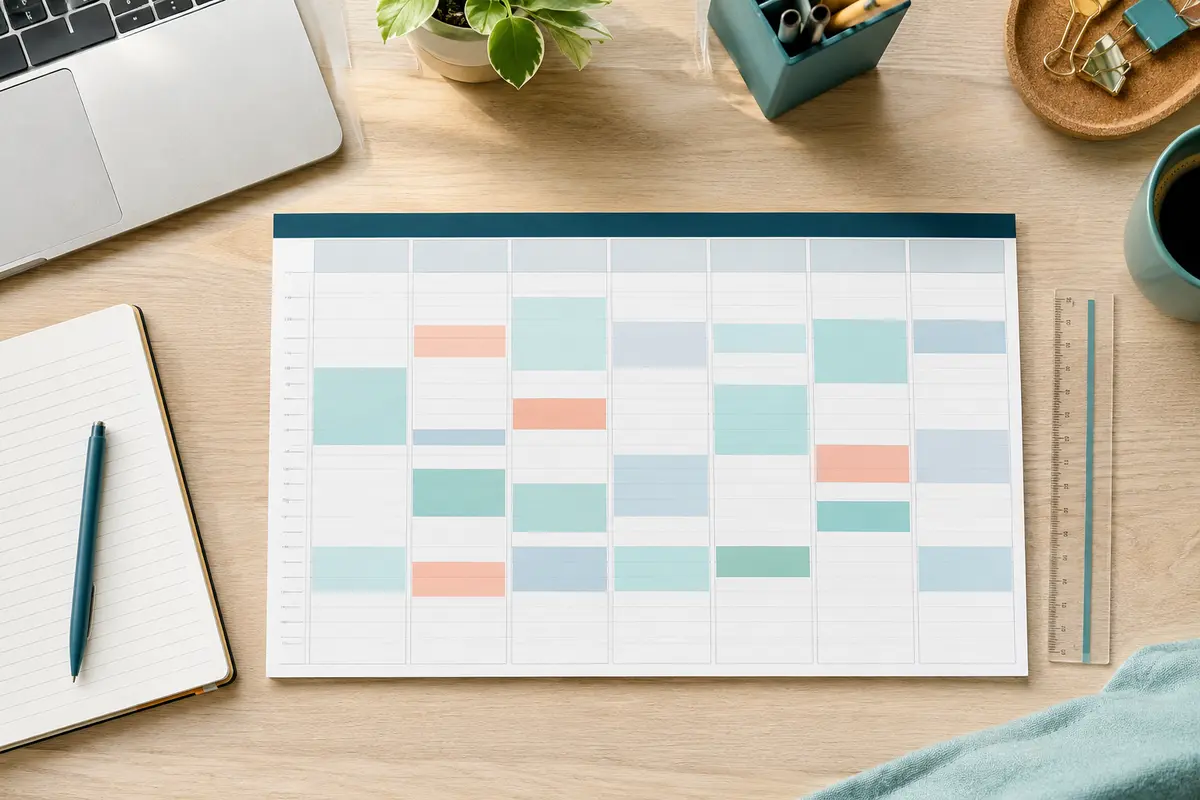
Filled Example for a 15-Credit Week
| Day | Main study block | Lighter block | Open time |
|---|---|---|---|
| Monday | Calculus problems, 3:30–5:00 PM | Biology lecture review, 7:00–7:45 PM | After 8:00 PM |
| Tuesday | History essay research, 2:00–3:30 PM | Spanish vocabulary, 6:30–7:00 PM | 7:00–9:00 PM |
| Wednesday | Chemistry problem set, 3:30–5:00 PM | Calculus error review, 7:00–7:45 PM | After 8:00 PM |
| Thursday | History draft, 2:00–3:30 PM | Biology flashcards, 6:30–7:00 PM | 7:00–9:00 PM |
| Friday | Catch-up block, 2:00–3:30 PM | Check next week’s deadlines | Evening |
| Saturday | Project work, 10:00–11:30 AM | Reading, 1:00–1:45 PM | Afternoon and evening |
| Sunday | Finish one priority, 11:00 AM–12:00 PM | Weekly reset, 6:00–6:20 PM | Most of the day |
How to Customize the Template
Add Course Workload, Not Just Class Time
Class meetings show where you must be, but assignments determine much of your remaining week. List the readings, projects, quizzes and problem sets due in the next seven days. Give longer or more difficult work the earliest available focus blocks.
Use Specific Block Names
| Vague block | Useful replacement |
|---|---|
| Study chemistry | Complete equilibrium problems 1–15 |
| Work on paper | Draft the introduction and first section |
| Review history | Build a timeline from Chapters 5 and 6 |
| Prepare for quiz | Complete one closed-note self-test |
Protect Sleep, Meals and Breaks
A schedule is not balanced if academic work replaces every basic need. Add sleep, meals and movement before you treat remaining time as available. Cornell’s time-management guidance also recommends planning balanced activities and using regular times and places for study.
Choose the Right Format
- Paper planner: useful if handwriting helps you remember and you prefer fewer notifications.
- Digital calendar: useful for recurring classes, reminders and quick changes.
- Spreadsheet: useful for estimating hours by course and tracking actual time.
- Scheduloom: useful for a clean visual timetable you can print or save.
Templates for Different College Students
- Balance employment and coursework with a working student schedule.
- Give asynchronous lectures firm times with an online college schedule.
- Plan around your first semester using the college freshman weekly plan.
- Separate labs, problem sets and projects with the STEM schedule template.
- Move demanding tasks later while protecting sleep with the night-owl study schedule.
For the full planning process, read how to build a study schedule for college. During exam season, use the separate guide to make a study schedule for finals.
Weekly Reset Checklist
- Check every course for new deadlines and announcements.
- Move unfinished work into a defined catch-up block.
- Estimate the next week’s major assignments.
- Place the hardest task during your best focus window.
- Check work shifts, appointments and travel time.
- Keep at least one part of the weekend open.
How This Template Was Checked
I tested the template against Scheduloom’s current weekly calendar workflow on August 29, 2026. I also compared its structure with Cornell Learning Strategies Center recommendations to schedule fixed commitments, balanced activities and specific study tasks. The filled example is a planning model, so students should adjust block length and
timing from their own course demands.
How to Fill In the Template: A Worked Example
Take Maya, a sophomore taking 15 credits: Biology II (4 credits with lab), Statistics (3), English Composition (3), Psychology (3), and a 2-credit seminar. Her fixed commitments go in first: classes, a 12-hour-a-week campus job, and sleep. She assigns Biology 9 hours (lab-heavy), Statistics 7, English 5, Psychology 5, and the seminar 2, leaving 2+ buffer hours. The key move: she names every block (“Biology: redo lab calculations,” not “study”), so each session starts without a decision.
Customizing the Template by Major Type
Lab-heavy majors: split each course into pre-lab prep, the lab, and post-lab write-up. Reading-heavy majors: 45-minute reading blocks with a 5-minute blank-page recall at the end. Problem-set majors: alternate solo problem-solving days with review days.
Three Mistakes That Break Most Templates
1. Scheduling every free hour: leave at least 10% of waking hours unscheduled as a buffer. 2. Copying someone else’s template exactly: adjust hours-per-course to your actual difficulty. 3. Never revising it: spend 15 minutes every Sunday comparing planned vs actual and move blocks that consistently fail.
Turning the Template Into a Daily Checklist
Each evening, pull the next day’s blocks from the template and write the single concrete task for each (“Statistics: problem set 7, questions 1-12”). This two-minute habit removes the morning decision of where to start.
FAQs
Should I make a daily or weekly study schedule?
Use a weekly schedule to see classes, deadlines and workload together. Then write a short daily priority list for the exact tasks you will complete. The weekly view prevents conflicts, while the daily list keeps each session clear.
How much empty time should a study template include?
Keep at least one catch-up block and some unassigned time during the week. The precise amount depends on your course load and responsibilities, but a template with no flexibility is likely to fail when one task takes longer than planned.
Can I reuse the same template every semester?
Reuse the structure, but rebuild the actual blocks whenever class times, course difficulty, work shifts or commuting change. Review the template after the first week and again after the first major assignment or exam.





3 Comments