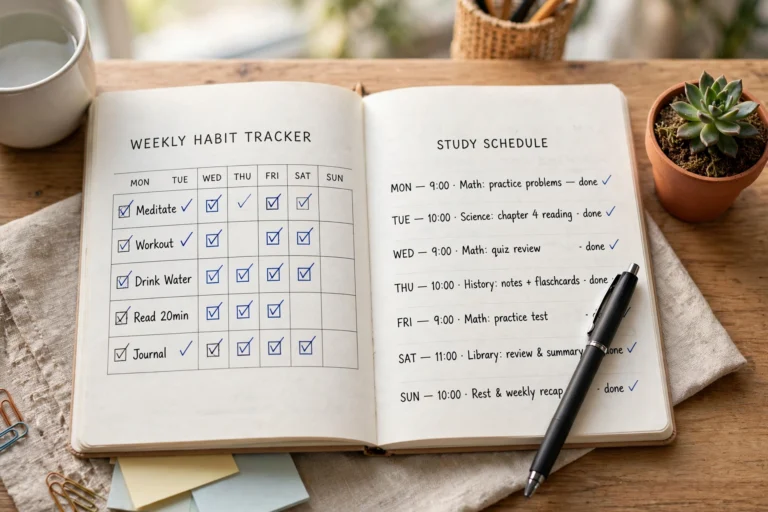
Study Schedule for Graduate Students: Research + Coursework
By Ashraf
Last Reviewed: October 16, 2026
A study schedule for graduate students has one job that undergraduate schedules do not: protect long, uninterrupted research blocks while coursework, teaching, and seminars fight for the same hours. What works is a weekly template: non-negotiable research mornings, batched coursework, contained teaching duties, and a Friday review that keeps your thesis moving even in heavy teaching weeks.
Build the template once in the free College Schedule Maker, then reuse it every week.
Quick Answer: How Do Graduate Students Balance Research and Coursework?
Give research the best hours of the day first: 2 to 3 hour morning blocks, four or five days a week. Batch coursework (readings, problem sets, seminar prep) into afternoon blocks, and keep teaching inside its scheduled hours plus one prep block. Review thesis progress every Friday for 30 minutes, and plan next week’s research tasks in writing. Coursework expands to fill all available time unless research gets scheduled first.
Why Graduate Schedules Break Down
Graduate students rarely fail from lack of effort. They fail from a schedule with no priorities: Coursework cannibalism. Seminars have weekly deadlines; research has distant ones. The urgent eats the important, and the thesis stalls for a semester. Fragmented research time. Thirty minutes between meetings is useless for deep work, but most grad calendars are built from exactly those gaps. Teaching creep. Preparation, grading, and student emails expand silently until teaching owns the week. No defined “done.” Undergrad work ends at submission. Research never ends, so without weekly milestones, progress never feels real. The schedule below counters all four: research first in long blocks, coursework batched, teaching contained, Friday milestones making progress visible.

The Graduate Weekly Template
This model assumes coursework, a teaching assistantship, and active thesis research. Adjust the ratios, but keep the order: research first. If your lab demands morning presence, theme your days instead: two for research, two for teaching and coursework, one for admin.
Table (columns: Day | Morning: research (protected) | Afternoon: coursework + teaching): Monday | 8:30 to 11:30 AM: thesis writing/analysis | 1:00 to 2:30 PM: seminar readings; 3:00 to 5:00 PM: teaching. Tuesday | 8:30 to 11:30 AM: thesis writing/analysis | 1:00 to 3:00 PM: coursework; 3:30 to 4:30 PM: grading batch. Wednesday | 8:30 to 11:30 AM: thesis writing/analysis | 1:00 to 2:30 PM: seminar prep; 3:00 to 5:00 PM: teaching. Thursday | 8:30 to 11:30 AM: thesis writing/analysis | 1:00 to 3:00 PM: coursework; 3:30 to 4:30 PM: lab/meetings. Friday | 9:00 to 10:00 AM: weekly research review | 10:30 AM to 12:00 PM: catch-up and planning; afternoon off or light reading. Weekend | One 2-hour block if needed | Protect at least one full day off.
Twelve to fifteen protected research hours per week is realistic. That sounds small until you compare it with what most students get: zero, because research was “planned” for gaps that never materialized.
Protecting the Research Block
The morning research block is the most valuable time of your week. Defend it: 1. No meetings before noon. State it once to your advisor and collaborators, then hold it. People respect stated boundaries, not unstated wishes. 2. Phone in another room. Research blocks die from “quick checks,” not emergencies. 3. One defined task per block. “Draft the methods section” or “run the regression on the cleaned dataset.” Never “work on thesis.” 4. Stop at the boundary. Ending on time keeps the block credible. If you are mid-thought, jot the next sentence as a note and stop.
When a week cannot hold the blocks (conference travel, grading avalanches), schedule one two-hour “research maintenance” session instead of canceling. A thin thread of progress beats a broken one. If focus slips, the timed technique in our Pomodoro study schedule helps: four focused 25-minute rounds per block, with real breaks between them.
Write From Year One, Not Just the Dissertation Year
Leaving all writing for the final year is a classic mistake. Writing improves with practice, and steady writing from the start makes the thesis far easier: Literature reviews in pieces. Summarize every paper you read in two or three sentences in a running document. After a year, you own a lit-review draft instead of a stack of forgotten PDFs. Methods as you go. Write up your method the week you use it, not a year later. Real milestones. Conference abstracts, progress reports, and journal papers are writing practice with deadlines: training for the dissertation. Meet your advisor every one to two weeks with written progress. A short written update turns activity into output.
Batching Coursework Efficiently
Graduate coursework should be handled, not savored. The research is the point. Read strategically. For seminars, read the intro, conclusion, and one key section deeply. Skim the rest. Prepare two discussion points per reading: that is what seminars reward. Batch similar tasks. Grade in one 60 to 90 minute block, read in another. Switching between grading, reading, and email triples the time each takes. Use templates. Keep a standard seminar-response format, standard email replies for common student questions, and a grading rubric that makes decisions fast. Contain email. Check course email twice daily at fixed times, not between tasks. Students survive a four-hour reply delay; your thesis does not survive constant interruption. Let roles overlap: turn a seminar paper into a literature-review section, or use teaching prep to deepen your grasp of your field. One hour serving two goals is an hour found twice. If a brutal stretch includes a big exam, our two-week exam study plan shows how to compress prep without touching research blocks.
Managing Teaching Without Losing Research
Teaching assistantships pay the bills, but they expand without limits unless you contain them:
Table (columns: Containment tactic | How): Fixed prep block | One 60 to 90 minute block per week. When it is over, prep is over. Grading batches | Grade in scheduled blocks with a rubric. Never “a few papers” between other tasks. Office-hour boundaries | Hold stated hours. Do not answer course questions all evening by message. Template everything | Standard announcements, feedback phrases, extension policy.
If teaching hours exceed your contract, document them and raise it with your advisor or department. Protecting research time is professional training, not indulgence.
The Long View: Yearly, Monthly, and Weekly Calendars
A weekly template handles the routine, but graduate school also runs on long horizons: qualifying exams, conference submissions, grant deadlines, the defense. These creep up fast when you only look one week ahead: Yearly. Mark every major deadline: comprehensive exams, conference submissions, fellowship applications, your target defense. Plan at least a year ahead. Monthly. Add paper deadlines, chapter targets, and self-imposed milestones for the dissertation. A monthly view shows whether this semester’s template is enough. Weekly. Your day-to-day template from above, filled in with that week’s specific research tasks. The yearly view turns “I will finish the dissertation next spring” into “three chapters drafted by December.” Students who plan long horizons rarely get surprised.
The Friday Research Review (30 Minutes)
This is the highest-leverage half hour of a grad student’s week. Every Friday, answer in writing: 1. What moved this week? List concrete outputs: pages drafted, data cleaned, experiments run, papers read with notes. 2. What is the next milestone? Name the single next deliverable (a section draft, a figure, a lit-review subsection) with a date. 3. What is blocking it? Missing data, an unanswered email, a method you do not understand. Turn each blocker into a task for next week. 4. Next week’s research tasks. Write the specific task for each morning block before the week starts. Keep these reviews in one document. Over a semester they become a progress log for your advisor and proof to yourself that the work is accumulating. If the review keeps slipping, our guide on how to stick to a study schedule covers accountability systems that make routines hold.
Sustainable Rhythms: Avoiding Graduate Burnout
This schedule is demanding and stays sustainable only with real recovery. A study schedule for graduate students is not about the most hours; it is about protected deep work plus real rest: One full day off per week. Not “lighter work.” Off. A rested Monday morning block outperforms three exhausted evening ones. Exercise as a scheduled block. Treat it like a seminar: non-optional, on the calendar. It supports the sustained attention research requires. Social contact weekly. Isolation is common in research phases and erodes motivation quietly. One regular commitment is maintenance, not distraction. Watch the warning signs. Dreading the research block for weeks, being unable to start despite open time, or working constantly while producing nothing are signals to talk to someone, not to push harder. If a heavy semester threatens your grades, the Grade Calculator shows which courses need attention, so you can allocate scarce hours by impact instead of anxiety.
How This Guide Was Prepared
I built the weekly template above in Scheduloom’s calendar tool against a realistic graduate schedule (seminars, a 20-hour teaching assistantship, thesis research) and confirmed that protected research mornings, batched coursework, contained teaching hours, and a full day off fit without overlap.
FAQs
How many hours should a graduate student study per week?
Coursework-phase students typically need 10 to 15 hours for classes and readings plus 12 to 15 protected research hours, alongside teaching. Structure matters more than totals: 15 protected research hours beat 30 fragmented ones. Track your deep-work hours for two weeks before deciding whether you need more time or better boundaries.
Should research or coursework come first in the schedule?
Research goes first on the calendar, in the morning blocks, because coursework has built-in deadlines that claim any unscheduled time. Coursework defends itself; research does not. So the schedule has to defend research.
How do I make progress on my thesis during heavy teaching semesters?
Shrink but do not cancel: one two-hour maintenance block per week keeps the thread alive. Use it for the smallest next task (one figure, one paragraph, one annotated paper). Write methods and literature notes as you go, and use the Friday review to keep the milestone visible, so the semester ends with progress instead of a cold restart.
How can I fit writing into my week before the dissertation year?
Treat writing as a research-block activity from year one: draft literature-review summaries as you read, write up methods the week you use them, and use conference abstracts and progress reports as writing practice. Bring written progress to every advisor meeting. Small, steady writing compounds into a much easier dissertation year.
How do I avoid burnout in graduate school?
Protect one full day off weekly, exercise on a fixed schedule, keep one regular social commitment, and watch for warning signs like persistent dread or stalled output. Track your time honestly for a week or two: many students find the problem is fragmentation, not laziness. Burnout comes from unsustainable patterns, not single hard weeks, and the fix is structural: boundaries, rest, support.