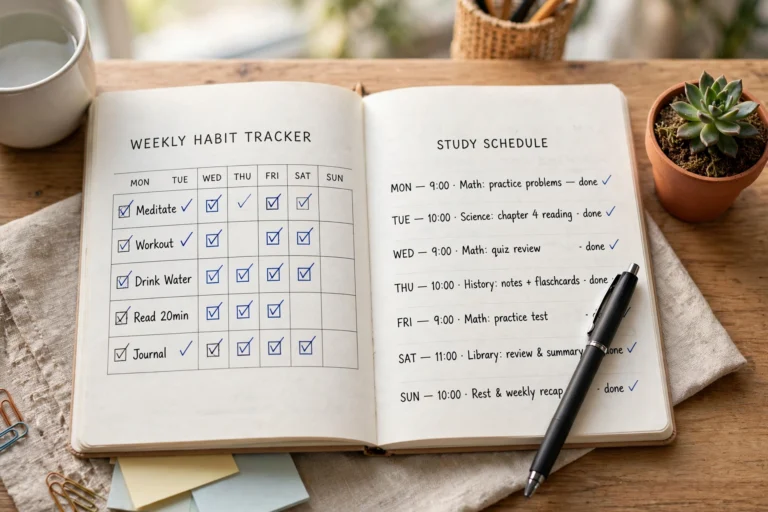
Weekend Study Schedule for Busy College Students
By Ashraf
Last Reviewed: October 16, 2026
A weekend study schedule should do three things: finish what the week left undone, prepare for the week ahead, and still leave real time off. The pattern that works is simple. Saturday is for deep work and catch-up. Sunday morning is for review and planning. Sunday afternoon is protected as a genuine break.
Build the weekend in the free College Schedule Maker so it sits next to your weekday plan. One visible timetable for the whole week keeps weekend plans from vanishing by Friday night.
Quick Answer: How Should a Busy Student Use the Weekend?
The best weekend study schedule is the one you can repeat every week. Block Saturday morning through early afternoon for your hardest unfinished work, while focus is still fresh. Use Sunday morning for a weekly review (what slipped, what is due, what needs preparing) and spend 30 minutes planning the coming week. Protect Sunday afternoon and evening for rest, because a weekend with zero recovery produces a Monday with zero focus. If you work weekends, shrink the same structure into the hours you actually have instead of skipping it.
How This Guide Was Prepared
This guide was built by: 1. Studying the most-read weekend study guides to find what they miss. 2. Reading real student discussions about weekend routines that survived a full semester. 3. Building two complete weekend models (free weekend and working weekend) and checking them against realistic class and job schedules. 4. Testing the Sunday review checklist against weekly planning guidance from university learning centers. 5. Keeping only advice simple enough to follow when you are tired.

The Golden Rules of Weekend Study
Table (columns: Rule | Why it matters): Front-load the weekend | Saturday morning focus is the week’s best remaining study fuel, do not spend it on errands. Name every block | “Finish statistics problem set 6” starts, “study” does not. One full half-day off | Recovery is part of the schedule, not a reward for finishing. Review before planning | You cannot plan next week until you know what this week left behind. Cap total hours | 4 to 6 focused hours across the weekend beats 10 distracted ones.
Weekend study fails in two predictable ways: the marathon (ten hours on Sunday night, fueled by panic) and the vanishing weekend (good intentions, zero blocks, everything pushed to Monday). Both are fixed by the same thing: a written plan with named blocks and a hard stop.
The Standard Weekend Schedule
For a student whose weekdays are full of classes, with the weekend free: Saturday: deep work and catch-up.
Table (columns: Time | Block): 9:00 – 10:30 AM | Hardest unfinished task: the problem set, essay draft, or lab report you avoided all week. 10:45 AM – 12:00 PM | Second priority: readings or assignments due early next week. 12:00 – 1:30 PM | Lunch and a real break, leave the desk. 1:30 – 2:30 PM | Catch-up: whatever slipped during the week, or get ahead on one task. 2:30 PM onward | Weekend begins: social time, errands, rest.
Sunday: review, plan, recover.
Table (columns: Time | Block): 10:00 – 10:45 AM | Weekly review: check every syllabus, note what is due in the next 14 days. 10:45 – 11:30 AM | Prepare: skim next week’s readings, gather materials, set up the calendar. 11:30 AM – 12:00 PM | Plan: place next week’s study blocks on the timetable. Afternoon onward | Off, genuinely off, no “quick” study tasks.
Total focused study: about 5 hours across two days. That is enough to enter Monday ahead instead of behind, and small enough to actually happen.
The Working Student’s Weekend
If you work Saturday and Sunday, a standard weekend study schedule does not fit. You get fragments instead, and fragments work when they are planned:
Table (columns: Available window | Best use): Saturday before or after shift (60 to 90 min) | One deep task: the single most important unfinished item. Sunday before or after shift (45 to 60 min) | Weekly review plus planning the next week. One weekday evening swap | Move one weekday study block to a free evening to keep weekly hours stable.
Three tactics make fragments work. First, decide the task before your shift, not after. Decision fatigue after work kills starting. Second, use the smallest effective block. 45 focused minutes after a shift beats a planned two hours that never starts. Third, protect one longer block somewhere in the week (a free weekday morning works well) for deep work like essay drafts. Our full guide to a study schedule for working college students covers this in detail, and short timed sessions from the Pomodoro study schedule fit perfectly into post-shift fragments.
What the Sunday Review Should Cover
The 45-minute Sunday review is the highest-value block of the week and the engine of any good weekend study schedule. Work through this checklist every time: 1. Deadlines: Scan every syllabus and portal for the next two weeks. Put each deadline on the calendar with a preparation block before it. 2. Slippage: What did not get done this week? Move each item to a specific block next week, not “later,” a real block. 3. Preparation: Skim next week’s readings and note which ones are heavy. Gather any materials you will need. 4. Energy audit: Which blocks worked and which were skipped? Move skipped block types to times that actually happened. 5. One priority: Name the single most important academic task for the coming week. Everything else is secondary. Students who do this review say the same thing: Monday stops feeling like an ambush.
Fitting Weekend Study Around Real Life
A schedule that ignores your life gets ignored. Adjust the model to yours: Athletes and performers: Put deep study before practice, when focus is fresh. Post-practice study is low quality. Commuters: Use travel time for audio review (recorded lectures, voice summaries you record yourself) and keep desk blocks for writing and problem solving. Parents and caregivers: Two 90-minute blocks during nap time or after bedtime, planned with family help, beat hopeful “I will study when I can.” Social commitments: Schedule them. A planned Saturday night out protects the study blocks around it. An unplanned one eats them.
Weekend Study Mistakes to Avoid
The Sunday night marathon. Cramming the weekend into Sunday evening means studying exhausted and anxious, the worst combination for memory. No hard stop on Saturday. “Just one more hour” repeated five times turns a recovery afternoon into a resentful evening. Studying without a list. Opening the weekend with “I should study” produces three hours of reorganizing notes. Open with named tasks from your Friday review. Skipping the Sunday review when behind. The review feels optional when real work piles up, but it is what stops next week from looking like this one. Copying a classmate’s weekend. The student posting library selfies at 8 AM Saturday may have no weekday job. Match the schedule to your life, not theirs. If one course is eating all your weekend hours, check the math first. Use the Grade Calculator to see which courses actually move your GPA, and give your scarce weekend blocks to those first.
How Do I Stop Wasting My Weekends?
Name every block before the weekend starts, during a short Friday review, not on Saturday morning. A weekend with named tasks and times gets used. A weekend with intentions gets scrolled away. Put the blocks on one visible timetable so “later” has a specific time attached to it. Then protect the plan the way you protect a class: it happens unless something truly urgent replaces it, and the replacement gets its own block too.
FAQs
How many hours should I study on the weekend?
A realistic weekend study schedule has 4 to 6 focused hours across both days. That is enough to catch up and get slightly ahead. More than 8 hours usually means the weekday plan is broken and needs fixing, not that the weekend needs expanding.
Should I study both Saturday and Sunday?
Study on Saturday and review on Sunday morning, then take Sunday afternoon off. Two full study days lead to burnout by mid-semester. The half day of real rest is what makes the other day and a half sustainable.
What if I work weekends?
Use the fragment model above: one 60 to 90 minute deep task around Saturday’s shift, a 45 to 60 minute review and planning block around Sunday’s shift, and one longer block on a free weekday. Decide each task before the shift starts.
What if I have exams on Monday?
Shift the pattern. Do the Sunday review on Saturday morning, spend Saturday afternoon and Sunday on exam prep with timed practice and recall, and take Friday evening off instead. The principle stays the same: prepare, practice, then rest before the exam.
Is it better to get ahead or catch up on weekends?
Catch up first, then get ahead with whatever time remains. Unfinished work carries stress into the new week and compounds. Getting ahead on one task is a bonus, not the priority. If you are caught up by Saturday noon, spend the rest on next week’s heaviest reading.